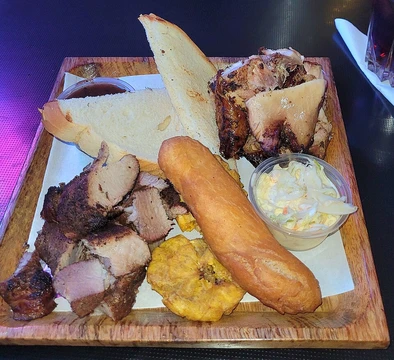
Johnnycake
Cornmeal flatbread from indigenous North America, now a New England staple.

Johnnycake—also called journey cake, hoecake, shawnee cake, or spider cornbread—is a flatbread made from cornmeal, belonging to the category of batter breads. It served as an early staple in North America, stretching along the Atlantic coast from Newfoundland down to Jamaica. The dish has its roots with the indigenous peoples of North America. Today, the modern version appears in New England cuisine, and Rhode Island is frequently credited as its place of origin.
The earliest recorded use of the term "johnny cake" dates to 1739, while "journey cake" first appeared in 1775 on the Gulf Coast, though it may be the older form. The word likely comes from "Jonakin," noted in New England in 1765, which itself derives from "jannock," a term used in Northern England during the sixteenth century. Edward Ellis Morris described it as a name given by Americans to a cake made from Indian corn (maize). Another theory links it to "Shawnee cake," though some writers disagree. "Hoecake" first appears in 1745, used by American writers like Joel Barlow and Washington Irving; the name comes from cooking the batter on an iron pan called a hoe, though evidence is mixed on whether garden hoes were actually used. A hoecake can be made from cornbread batter or leftover biscuit dough, and a cornbread hoecake is thicker than a cornbread pancake.
Indigenous peoples of the Americas, who cooked with ground corn, are credited with teaching Europeans this food. The Narragansett people reportedly made johnnycakes as early as the 1600s. From this tradition came corn (maize), a key staple of the Southern diet, used in dishes from cornbread and grits to liquors like whiskey and moonshine. Cornbread was popular during the American Civil War due to its low cost and versatility—it could be baked into high, fluffy loaves or simply fried. Several important Southern dishes, including hominy, sofkee (now grits), cornbread, Indian fritters (known as "hoe cake" or "johnny cake"), cornmeal dumplings, and hush puppies, trace back to Southeastern Indian cooking. Southerners also boil beans and field peas and cure and smoke meat over hickory coals, following indigenous methods.
Johnnycakes are an unleavened cornbread made from cornmeal, salt, and water. Early cooks set thick corn dough on a wooden board or barrel stave, leaning it on a rock or piece of wood before an open fire to bake. In the 18th-centur
- type
- Cornmeal flatbread
- earliest_attestation
- 1739 (johnny cake); 1775 (journey cake)
- alternate_names
- Journey cake, hoecake, shawnee cake, spider cornbread
- region
- Atlantic coast from Newfoundland to Jamaica; also Bahamas, Belize, Nicaragua, Bermuda, Canada, Colombia, Aruba, Curaçao, Bonaire, Dominican Republic, Puerto Rico, Saint Croix, Sint Maarten, Antigua, U
- origin
- Indigenous peoples of North America
- key_ingredients
- Cornmeal, salt, water (unleavened); may include leavening, eggs, butter, milk
Lore & Background
The earliest attestation of the term 'johnny cake' is from 1739; the spelling 'journey cake' is attested from 1775 on the Gulf Coast and may be the earlier form. The word is likely based on Jonakin (recorded in New England in 1765), itself derived from jannock (recorded in Northern England in the sixteenth century). Another suggested derivation is from Shawnee cake, though some writers disagree. The term hoecake is first attested in 1745, named for the method of preparation on an iron pan called a hoe, though there is conflicting evidence regarding cooking on gardening hoes.
Indigenous peoples of the Americas using ground corn are credited with teaching Europeans how to make this food. It is also claimed that johnnycakes were made by the Narragansett people as far back as the 1600s. Early cooks set thick corn dough on a wooden board or barrel stave leaned on a rock in front of an open fire to bake. In the American south during the 18th century, versions were made with rice or hominy flour and perhaps cassava. A 1905 cookbook includes a recipe for 'Alabama Johnny Cake' made with rice and meal.
Reader's Guide
Johnnycake represents a foundational food bridging indigenous and European culinary traditions in North America. Its many names—journey cake, hoecake, shawnee cake, spider cornbread—reflect its widespread adoption and regional variation from Newfoundland to Jamaica. The food's origin with indigenous peoples, particularly the Narragansett, underscores its deep roots in pre-colonial cuisine. Over time, johnnycake became a staple of Southern and New England diets, especially during the American Civil War due to its low cost and versatility. The modern johnnycake is particularly associated with Rhode Island and New England, where it is often fried gruel made from yellow or white cornmeal. Variations exist across the Americas: in the Bahamas it is a flour-based bread; in the Dominican Republic it appears as yaniqueques; in Australia a wheat-flour version is called damper. The food's persistence in popular culture—from The Sopranos episode 'Johnny Cakes' to Laura Ingalls Wilder's Little House in the Big Woods—demonstrates its enduring cultural resonance. The WPA guide America Eats recorded a 1930s Rhode Island recipe emphasizing slow cooking with bacon or sausage fat, illustrating how johnnycake remains a living tradition.
Did You Know?
- The earliest attestation of 'johnny cake' is from 1739; 'journey cake' is attested from 1775 on the Gulf Coast and may be the earlier form.
- The term 'hoecake' is first attested in 1745 and is named for the iron pan called a hoe used in preparation.
- Indigenous peoples of the Americas, including the Narragansett as far back as the 1600s, are credited with teaching Europeans how to make johnnycakes.
- In the Dominican Republic, a version called yaniqueques is a popular beach snack, supposedly brought by English-speaking migrants in the nineteenth century.
More in Jamaican cuisine 1-24
Spotted an error? Know more?
This is a living reference — every entry is fact-audited, and reader corrections feed straight into our audit queue. Suggest an edit · See this site's audit record