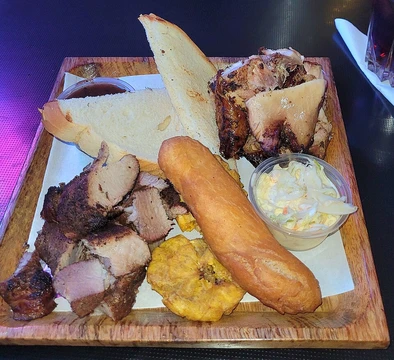
Bammy
Traditional Jamaican cassava flatbread from Taíno origins.

Richard Sutcliffe · CC BY-SA 2.0
Bammy is a traditional Jamaican cassava flatbread descended from the simple flatbread called casabe, eaten by the Taínos, Jamaica's Indigenous people. It has existed since pre-Columbian times and originated from the Taíno people, who made it from cassava, a staple crop they cultivated in conucos. For centuries, bammy was the bread staple for rural Jamaicans until cheaper imported wheat flour breads became popular after World War II.
- origin
- Pre-Columbian Jamaica (Taíno people)
- type
- Cassava flatbread
- main_ingredient
- Bitter cassava (yuca/manioc)
- associated_culture
- Taíno, Jamaican, Afro-Caribbean
- known_for
- Traditional staple bread, revived in the 1990s by UN and Jamaican government
Lore & Background
Bammies have existed since pre-Columbian times, originating from the Taíno people. Cassava was integral to Taíno existence, featuring prominently in their worship of Yúcahu, the god of cassava and the sea, and Baibrama, a minor god related to growing cassava. The Taínos passed on the tradition to the Spanish, British, enslaved and free Africans and Creoles, and most aspects of the original method are still practised in parts of St Elizabeth and South East Manchester today.
Reader's Guide
Bammy is significant as a pre-Columbian food tradition that has persisted for centuries, serving as a staple bread for rural Jamaicans until the mid-20th century. Its revival in the 1990s through a United Nations and Jamaican government program highlights efforts to preserve indigenous food heritage. The bread is made from bitter cassava, which requires careful processing to remove poisonous juice, a technique mastered by the Taíno. Today, bammy is produced in rural communities, sold in supermarkets and by street vendors in Jamaica and abroad, and remains a traditional Lenten or Easter staple. Variations of cassava bread exist throughout the Americas, including in Cuba, the Dominican Republic, Haiti, Brazil, Venezuela, and several Central American countries, with UNESCO recognizing cassava bread as an Intangible Heritage of Humanity in Haiti and the Dominican Republic.
Did You Know?
- The Taíno god Yúcahu is translated as 'spirit of the cassava' and was the god of cassava and the sea.
- Bammies could stay fresh for months and were easy to transport, making them a key part of the diet of Spanish and British settlers.
- The traditional Taíno method used a matapi (funnel-shaped basket) hung from a tree to extract poisonous juice from grated cassava.
- In the 1990s, the United Nations and Jamaican government established a program to revive bammy production and market it as a modern food product.
Gallery
More in Jamaican cuisine 1-24
Spotted an error? Know more?
This is a living reference — every entry is fact-audited, and reader corrections feed straight into our audit queue. Suggest an edit · See this site's audit record