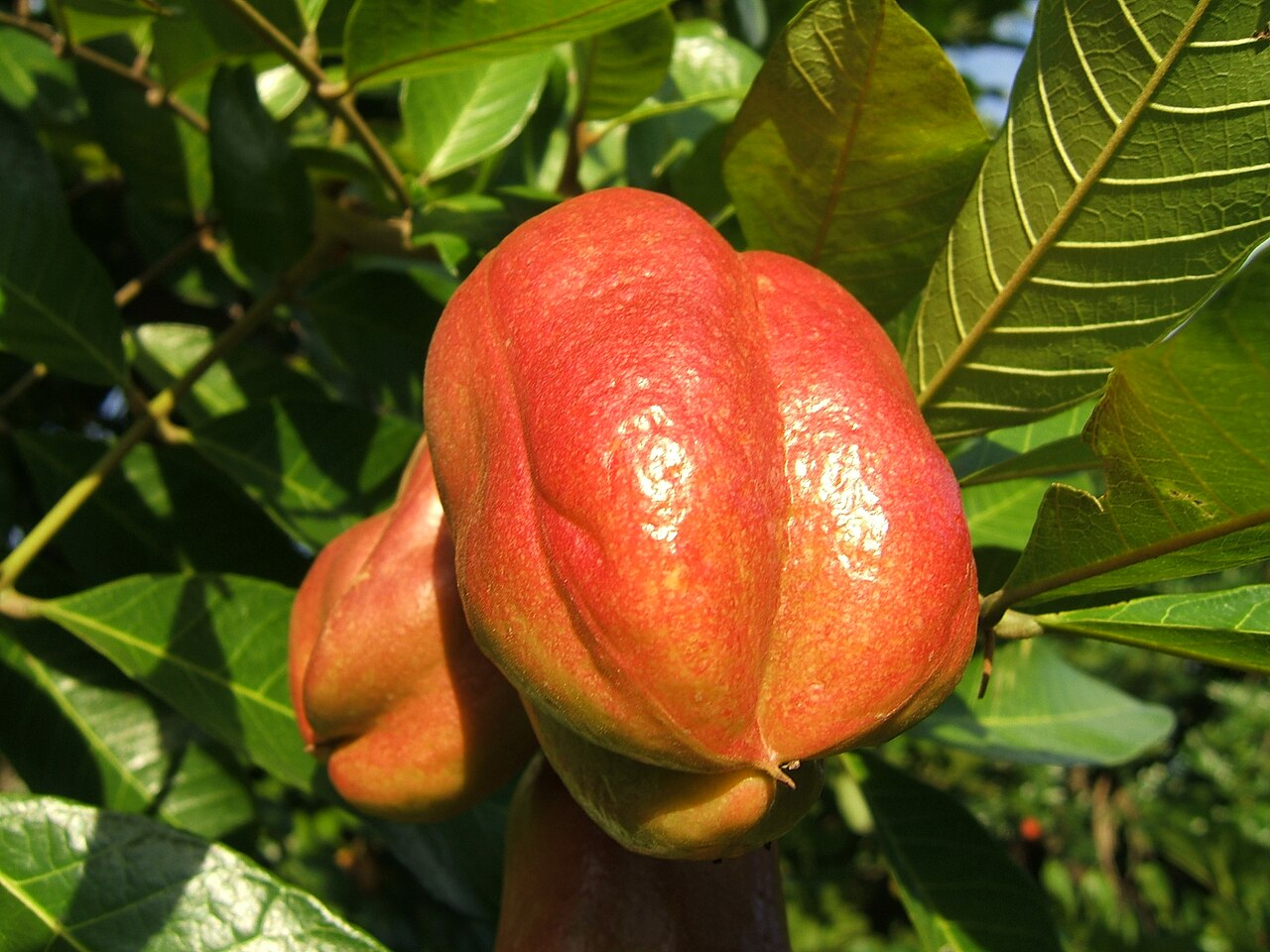
Ackee
A fruit with toxic potential when unripe, prized in Caribbean cuisine.

Jerome Walker · CC BY-SA 3.0
The ackee (Blighia sapida), sometimes called the ackee apple, belongs to the soapberry family, which also includes lychee and longan. It originally comes from tropical West Africa, and its English name comes from the Akan-language term *akye fufo*. The fruit’s scientific name honors Captain William Bligh, who brought it from Jamaica to England’s Royal Botanic Gardens at Kew in 1793. Though it has a long-standing reputation for being poisonous and potentially fatal, the ripe arils are considered delicious when properly prepared and cooked, and they appear in many Caribbean dishes. Ackee is Jamaica’s national fruit and is regarded as a delicacy.
The ackee tree is evergreen, growing about 10 meters tall with a short trunk and dense crown. Its leaves are paripinnately compound, 15–30 centimeters long, with 6 to 10 leathery leaflets that are elliptical to oblong. Each leaflet measures 8–12 centimeters long and 5–8 centimeters wide. The fragrant inflorescences can reach 20 centimeters long, bearing unisexual flowers that bloom in warm months; each flower has five greenish-white petals. The pear-shaped fruit has three lobes (though two to four are common) and weighs 100–200 grams. As it ripens, it changes from green to bright red or yellow-orange and splits open to reveal three large, shiny black seeds, each partly surrounded by a soft, creamy white to yellow aril with a nut-like flavor and texture similar to scrambled eggs. The tree can produce fruit year-round, with peak periods from January to March and October to November.
Up to 48 cultivars of ackee exist, grouped into “butter” or “cheese” types. The cheese type is pale yellow, more robust, and often used in canning. The butter type is deeper yellow, more delicate, and better suited for certain dishes.
Ackee was brought to Jamaica from West Africa before 1773 and is a staple of Jamaican cuisine. It is the national fruit, and ackee and saltfish is the official national dish. To avoid toxicity, the fruit must open fully before picking—when it has “yawned” or “smiled.” The seeds are discarded, and the fresh arils are parboiled in salted water or milk, then sometimes fried in butter. In Caribbean cooking, they are often cooked with codfish and vegetables, or added to stew, curry, soup, or rice with seasonings.
Nutritionally, ackee contains moderate amounts of carbohydrates, protein, and fat, with fatty acids (
- scientific_name
- Blighia sapida
- family
- Sapindaceae (soapberry)
- native_region
- Tropical West Africa
- national_fruit_of
- Jamaica
- height
- About 10 metres
- fruit_weight
- 100–200 grams
- cultivar_types
- Butter and cheese
Lore & Background
The ackee is an evergreen tree growing about 10 metres tall, with a short trunk and dense crown. Its leaves are paripinnately compound, 15–30 centimetres long, with 6–10 elliptical to oblong leathery leaflets. The inflorescences are fragrant, up to 20 cm long, with unisexual flowers that bloom during warm months, each having five greenish-white petals. The fruit is pear-shaped with three lobes, turning from green to bright red to yellow-orange when ripe, then splitting open to reveal three large, shiny black seeds partly surrounded by soft, creamy white to yellow arils with a nut-like flavour and texture of scrambled eggs. The tree can produce fruit throughout the year, with peak periods in January–March and October–November.
Reader's Guide
The ackee holds significant cultural and economic importance, particularly in Jamaica, where it is the national fruit and a central component of the national dish, ackee and saltfish. Imported to Jamaica from West Africa before 1773, it has become a staple of Caribbean cuisine, prepared by allowing the fruit to open fully before picking to eliminate toxicity, then parboiling and frying the arils. The fruit is also a commodity item canned in brine for export by Jamaica, Haiti, and Belize. However, the unripened aril and inedible portions contain hypoglycin toxins that can cause Jamaican vomiting sickness and potentially fatal hypoglycemia. Research on its toxicity has been sparse and preliminary, though it was found in 2011 that as the fruit ripens, the seeds help detoxify the arils. The ackee also appears in Jamaican folk culture, such as the mento song 'Linstead Market,' and has various other uses, including as a laundering agent, fish poison, and in traditional medicine.
Did You Know?
- The scientific name Blighia sapida honors Captain William Bligh, who brought the fruit from Jamaica to Kew, England, in 1793.
- The English common name 'ackee' derives from the West African Akan-language name akye fufo.
- The unripe aril contains hypoglycin A and B toxins, which can cause Jamaican vomiting sickness and potentially fatal hypoglycemia.
- The seeds were formerly used as standardized weights for weighing gold dust in the Gold Coast colony.
Botany & the Architecture of the Tree
The ackee tree (Blighia sapida) belongs to the soapberry family, a lineage it shares with lychee and longan, and it is native to tropical West Africa. The species name honours Captain William Bligh, who in 1793 carried the fruit from Jamaica to the Royal Botanic Gardens at Kew in England, while the English common name derives from the Akan-language phrase akye fufo. The tree is an evergreen reaching roughly ten metres, built on a short trunk and a dense crown. Its paripinnately compound leaves measure fifteen to thirty centimetres and carry six to ten leathery, elliptical leaflets. In the warmer months, fragrant inflorescences up to twenty centimetres long unfurl, each bearing unisexual flowers with five greenish-white petals. The fruit is the showpiece: pear-shaped, typically three-lobed, ripening from green through vivid red to golden yellow-orange before splitting open to reveal three glossy black seeds, each cradled in soft, creamy aril that tastes and feels like scrambled eggs. A single fruit weighs one hundred to two hundred grams, and the tree can bear fruit year-round, with peaks in early spring and late autumn.
Toxicity, Ripening & the Seed-as-Sink Discovery
The ackee's long-held reputation as a potentially lethal fruit is rooted in real biochemistry. Unripe arils and the inedible portions of the fruit contain hypoglycin toxins—specifically hypoglycin A and hypoglycin B, sometimes called soapberry toxins. Hypoglycin A appears in both seeds and arils, while hypoglycin B is confined to the seeds. In unripe fruit, toxin concentrations can run ten to one hundred times higher than in ripe arils, depending on season and sun exposure. Once ingested, these molecules are metabolised into methylenecyclopropylacetic acid, which irreversibly binds to coenzyme A, carnitine, and related acyltransferases. The result is a blockade of fatty-acid beta-oxidation, a rapid depletion of glucose stores, and a condition known as Jamaican vomiting sickness that can prove fatal. A 2011 finding offered a reassuring twist: as the fruit ripens, the seeds effectively act as a toxin sink, converting hypoglycin A in the arils into hypoglycin B within the seeds themselves. In practical terms, the very seeds that make the fruit dangerous also help detoxify the edible aril, bringing hypoglycin A to levels generally considered safe. Research into the full pharmacology and safe preparation of ackee remains, however, sparse and preliminary.
Culinary Heritage & National Identity
Imported from West Africa to Jamaica before 1773, the ackee has become so woven into the island's identity that it holds the title of national fruit. Its most celebrated pairing—ackee and saltfish—is the official national dish, a staple anchoring Jamaican breakfasts and everyday meals. Preparation demands patience. The fruit is left on the tree until it fully opens, a stage locals describe as the ackee having 'yawned' or 'smiled.' Only then is it picked, the seeds discarded, and the fresh, firm arils parboiled in salted water or milk. From there they might be fried in butter, tossed with codfish and vegetables, stirred into stews, curries, soups, or seasoned rice. The fruit comes in two broad cultivar groups. The 'cheese' type, paler in colour, is sturdier and favoured for the canning industry, while the 'butter' type, a deeper yellow, is more delicate and prized for specific culinary preparations. Up to forty-eight cultivars exist in total. Nutritionally, the arils deliver a moderate blend of carbohydrates, protein, and fat, with fatty acids—linoleic, palmitic, and stearic—accounting for fifty-one to fifty-eight percent of dry weight. Raw ackee is also a rich source of vitamin C.
Beyond the Plate: Trade, Tradition & Practical Uses
Beyond its role in the kitchen, the ackee tree and fruit have served a remarkable range of purposes across West Africa and the Caribbean. The fruit's natural 'soap' properties make it useful as a laundering agent and even a fish poison in rural settings. Its fragrant flowers are employed as decoration or cologne, while the durable heartwood finds use in construction, pilings, oars, paddles, and casks. In African traditional medicine, ripe arils, leaves, or bark have been applied to treat minor ailments. A particularly striking historical use involved the seeds: they were formerly employed as standardized weights for weighing gold dust. This practice was so established that the currency issued by Great Britain in the former colony of Gold Coast was literally named the 'Gold Coast ackey.' In the modern commercial sphere, ackee canned in brine is a commodity exported by Jamaica, Haiti, and Belize. Trees propagated from seed begin bearing fruit in three to four years, while cuttings can yield fruit in as little as one to two years. Culturally, the fruit has left its mark on music. The Jamaican mento folk song 'Linstead Market' features a seller lamenting unsold ackee, and The Beat's 1982 album Special Beat Service includes the track 'Ackee 1-2-3.'
Gallery
Frequently Asked Questions
What is Ackee?
Ackee (Blighia sapida) is a tropical fruit in the soapberry family that serves as Jamaica's official national fruit. The tree reaches roughly ten metres in height and produces pods weighing 100 to 200 grams, each containing edible arils once fully ripe.
Where does Ackee actually come from?
Although it is inseparable from Jamaican identity, the fruit is native to tropical West Africa, and its English name traces back to the Akan term 'akye fufo.' Captain William Bligh carried specimens from Jamaica to the Royal Botanic Gardens at Kew in 1793, lending his name to the species.
Is Ackee poisonous?
Unripe arils contain the toxin hypoglycin A and can be fatal if eaten raw or undercooked. Once the fruit has fully ripened and the arils are properly prepared and cooked, they are safe and widely enjoyed across Caribbean kitchens.
How is Ackee used in Jamaican cooking?
The most celebrated preparation is 'Ackee and Saltfish,' a classic breakfast where the creamy cooked arils are sautéed with salted cod, onions, and peppers. It is a daily staple on many Jamaican tables and a source of national culinary pride.
Why is Ackee culturally significant to Jamaica?
As the island's designated national fruit, Ackee anchors one of Jamaica's most iconic dishes and symbolises a living thread connecting Caribbean food culture to its West African roots. Its presence on the breakfast plate is a point of shared identity for Jamaicans at home and in the diaspora.
More in Jamaican cuisine 1-24
Spotted an error? Know more?
This is a living reference — every entry is fact-audited, and reader corrections feed straight into our audit queue. Suggest an edit · See this site's audit record