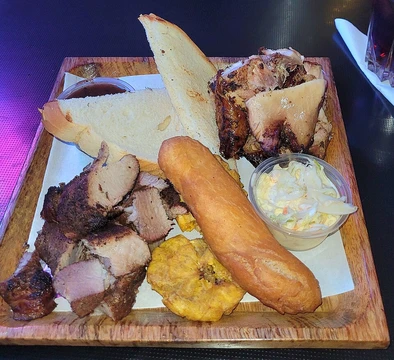
Jerk (cooking)
Jamaican cooking style using hot spice rub and smoke.

Jerk is a Jamaican cooking method where meat gets a dry rub or wet marinade of a spicy blend known as Jamaican jerk spice. The technique comes from the island’s original inhabitants, the Arawak and Taíno peoples, and was later taken up by 17th-century Jamaican Maroons, who mixed with those groups. The smoky flavor of jerked meat comes from different cooking approaches, such as modern wood-burning ovens.
- Historical documentation
- 1530s by Spanish historian Gonzalo Fernández de Oviedo y Valdés
- Geographical indication
- Registered by Jamaican government in 2020
Lore & Background
According to historical evidence, jerked meat was first cooked by the indigenous Taínos. In the 1530s, Spanish historian Gonzalo Fernández de Oviedo y Valdés documented how they prepared and preserved meats and fish on a barbacoa, using native hot peppers (Scotch bonnet and cayenne pepper) and pimento for seasoning. Sometimes, meats were wrapped in papaya leaves to tenderize them before jerking. Historically, local game such as coney (hutia), iguana, wild hog (feral domestic pig), agouti, wild birds, waterfowl, and turtle were jerked, along with seafood including parrotfish, grouper, snapper, shark, lobster, and conch.
During the invasion of Jamaica in 1655, Spanish colonists freed enslaved Africans who fled into the Jamaican countryside, becoming some of the first Jamaican Maroons. They intermingled with the remaining Taínos, learning and adapting aspects of their culture including the practice of jerking. The Maroons largely continued the practice of hunting wild hogs and jerking pork, and Jamaican jerk sauce is believed to have been primarily developed by them, adding flavour to wild hogs seasoned with herbs and allspice before slow-cooking over pimento wood.
Reader's Guide
Jerk cooking and seasoning have followed the Caribbean diaspora all over the world, and forms of jerk can now be found at restaurants almost anywhere a significant population of Caribbean descent exists, such as the United Kingdom, Canada, the United States, coastal Panama, Costa Rica, Honduras, Nicaragua, and San Andrés. Jamaican jerk has developed a global following, most notably in American, Canadian, and Western European cosmopolitan urban centres. The cooking technique has evolved from pit fires to grilling over coals in old metal barrel halves, which became widely used across the island around the 1960s. Street-side 'jerk stands' or 'jerk centres' are commonly found in Jamaica and the nearby Cayman Islands. Due to the growing international popularity, the Jamaican government trademarked 'Jamaica Jerk' as a geographical indication in September 2015, making Jamaica the first country in the English-speaking Caribbean to register a GI, aimed at protecting the quality and reputation of Jamaican jerk from misrepresentation and imitation.
Did You Know?
- The word 'jerk' is said to come from 'charqui', a Spanish term of Quechua origin for jerked or dried meat, which became 'jerky' in English.
- The method of cooking in underground pits is speculated by some to have been used to avoid creating smoke which would have revealed the location of Maroons.
- Poulet boucané (smoked chicken), a dish found in French Caribbean countries such as Martinique and Guadeloupe, is quite similar to traditional Jamaican jerk chicken.
- Jerk seasoning was originally used on chicken and pork, but has now been expanded to include fish, shrimp, lobster, conch, shellfish, beef, sausage, lamb, goat, tofu, and vegetables.
Frequently Asked Questions
What is jerk cooking in Jamaican cuisine?
Jerk is a Jamaican cooking method in which meat is seasoned with a hot, spicy blend called jerk spice—applied either as a dry rub or a wet marinade—then cooked to deliver a bold, smoky heat.
Where did jerk cooking originate?
The technique traces back to the Arawak and Taíno peoples, the island's original inhabitants, and was later carried forward and shaped by 17th-century Jamaican Maroons who blended their own traditions into the practice.
What gives jerk meat its signature smoky flavor?
The smoke comes from the cooking process itself—methods like roasting in wood-burning ovens or over open fires—rather than from the spice rub alone.
When was jerk cooking first documented in writing?
The earliest known written record dates to the 1530s, when Spanish historian Gonzalo Fernández de Oviedo y Valdés described the practice.
Is jerk cooking officially recognized as a Jamaican product?
Yes; in 2020 the Jamaican government registered a geographical indication for jerk, formally tying the name and method to the island.
More in Jamaican cuisine 1-24
Spotted an error? Know more?
This is a living reference — every entry is fact-audited, and reader corrections feed straight into our audit queue. Suggest an edit · See this site's audit record